Showing posts with label spiritual. Show all posts

Saturday, March 26, 2011

We Are What We Eat

In our world of instant gratification and over indulgence, we must be careful as to what we physically eat. When we eat the wrong things, our bodies become polluted.

How much more should we be careful what we feed our spiritual bodies. If we are partakers of the wrong foods spiritually, we chance polluting our minds to the point that it affects our thinking and our behavior.

Wednesday, January 26, 2011

Condition, please!

In what condition is our spiritual house?
Is it time for repair?

Thursday, January 20, 2011

Agitated & Run through the Wringer

NO! Oh NO! This 1950s advertisement doesn't show it like it really was. Believe me! It was everything but fun and glee.

I must admit that washing clothes doesn’t have the same meaning it used to. Thank the Good Lord for that! Nowadays, we just whip the clothes into our front loader or top loader machine, place the laundry agents into their designated slots, press a button or two, and poof - our load is off and running. When it goes through its automated cycles, we just a flip of the laundry into the dryer, push a few buttons, and off they go into a spin - and off we go too!

I don't want to be depressing or anything - nor do I wish for sympathy. That's not my point for posting this today. Read to the end and you'll find out why I chose such - or if you don't want to bother reading the whole thing, just go to the end for my reasoning.

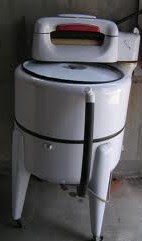
I remember this "monster". Well, calling it a "monster" is a
little harsh as it was better than using the older (non-electric)
washers or the basic scrub board. Hey, the more I look at it,
it's nice - really nice in comparison to the pre-monster types.

Washing our clothes was not magical as a girl. We had a Maytag wringer washing machine that would danced all over the back porch (thanks to its powerful gyrator). The gyrator was hailed as one of its major selling points. In all truth, this machine was one of the reasons ladies didn't have to go to the gym or watch what they ate. It was an exercise machine in itself. Well, if you had to chase the "monster" around the laundry porch, you'd agree. And yes, we had a laundry porch, which consisted of wash tubs, linoleum floor and wired screen around two sides of the room so to let the fresh air in during the cold, icy winter as well as the fresh air in during the hot, scorching summer. Hey, it was better than a wooden or concrete slab outdoors that many folks had. You know we should never complain if our laundry appliances are located in the garage. That would have been a blessing in my younger days. However, I must say that God is Good and I have been supremely blessed with an indoor laundry room for many, many years.

Now let's get back to my story. After the clothes were beaten too death, in that "modern form of 1950's technology", the next step was putting the clothes through the wringer. It was the process of taking the clothes out of the (usually) very hot, soapy water, then doing the wringer thing to take out excess water, only to purge them into a tub of cold water and wring again. Then if they were whites, it was into the bluing tub (blue liquid mixed with water to brighten clothes), wring them, and then drop them into a tub of cold water. The last wring for either the whites or coloreds was to wring them out AGAIN as dry as possible and place them in the clothes basket (wooden-weave, no plastics at that time - we were more environmentally- friendly at that time).
Unfortunately, sometimes more than the clothes got wrung - on occasion it was a sleeve of what you were wearing or your hand. Yes, a Hand. In panic mode, you'd hit the wringer release (if you could think above the pain) and pull out whatever was caught. I was a 9 or 10 year old girl so you can imagine the drama. (Often thought I should have gone into acting because I was pretty good - the screams and sobs were so natural). Truthfully, it was quite an ordeal at any age! If it was a hand, you'd let it lie there like a wet mop while turning ashen with tears gathering in the corners of your eyeballs. If it was your clothes that had a traumatic wring, it meant considering repair with needle and thread.

Oh, I forgot to mention that if you wanted shirts, blouses, skirts, dresses, hankies and sheets (yes, sheets! - nothing like a starched sheet to make for comfy bedding), a pan of starch was a must. With a conglomeration of powdered substance and water mixed in a large pan, you'd drop the selected clothing in the pan one by one, and gently agitated them with your hand – and after that? You got it, the wringer experience again.

We didn't own an electric or gas clothes dryer. In fact, dryers were rare at that time and not very proven as to their working condition. Well, truth was that many clothes ended up with burnt spots - and since it wasn't kosher to wear scorched clothing, my family elected to use nature's dryer. This sophisticated drying system consisted of several wire lines stretched between two posts, with clothes being held (prisoner) by wooden clothes pins. The Result of such labor: Sheets were stiff even without starching and ironing (but smelled sunshine fresh). Towels were rough (imagine drying a wet body with them - an experience in itself especially when taking a morning shower while half awake - scratch, scratch). All colored clothes would fade in no time (unless turned inside out when put on line but they’d still be stiff and still faded, only slower). And the unmentionables? Yes, they had their place - exposed for the world to see unless you hide them neatly in-between the rows of sheets and towels. And just think of their feel!

It took the greatest part of the day as normally laundry was done once a week - on Mondays (because Tuesday was ironing day - and since no-iron clothing didn't exist, it meant Iron poor soul, Iron! That is, all except the towels.). Well, I won’t even tell about the ironing process (if I did, I'd set myself up for a nightmare or two - if the washing hasn't already).

Well, I said all that to say this:
Washing clothes is a parallel to our walk with the Lord. Being a real Christian means we must be spiritually clean which means, at times, we must be aggressively agitated, placed in a tub of hot water, run through the wringer (perhaps several times), and then hung out to dry for the whole world to see. And because of the nature of man, we will probably need to be rewashed next Monday (if not sooner).

Wednesday, January 12, 2011

Don't Be in a Hurry

Flowers do not force their way with great strife.
Flowers open to perfection slowly in the sun....
Don't be in a hurry about spiritual matters.
Go step by step, and be very sure.

- White Eagle

Monday, October 11, 2010

A Wise Builder

Wouldn't it be wise for us to check our spiritual foundation daily? Truly, it is extremely important how our foundation is built as there are many dangers seeking to begin the erosion, destruction, or collapse of the very base of our spiritual being.

Tuesday, August 31, 2010

Time for Oil Check


Lately, have you checked to see if
your soul's lamp is filled with (spiritual) oil?


Food for Thought:
Lampante oil as it was called in Biblical times was not used for consumption but as fuel for oil-burning lamps. From this ritual of anointing, the expected savior of the Jews was called the Messiah "anointed one". Olive oil in contemporary religious use also has religious symbolism related to healing and strength and to consecration, God setting a person or place apart for a special work.

Monday, September 29, 2008

Building Our Bridge

During the time of the Incas, communities in Peru who lived near a river would build marvelous hanging bridges out of rope, hand woven of qqoya grass (a type of Andean bunchgrass). These handmade bridges were a means of transportation for people, their goods, and livestock. The bridge construction amounted to a pair of stone anchors on each side of the canyon with massive cables of woven grass linking the two pylons together. Two additional cables acted as guardrails. The cables which supported the foot-path were reinforced with plaited branches. The bridges were so heavy that they tended to sag in the middle, causing them to sway, sometimes violently, in high winds. Some bridges spread 220 feet across the canyon, and 118 feet above the river. What spectacular sights, these massive bridges – breathtakingly hanging over treacherous canyons and gorges, while tumult rivers loomed beneath.

The tradition of the suspension bridge continues today. Each June, hundreds of people join in the mountain community of Huinchiri in southeast Peru to rebuild a contemporary bridge in celebration of their cultural heritage and to honor their ancestors and religious beliefs. The process takes three days of round-the-clock work, with the women braiding thousands of pounds of sturdy, stout straw into ropes, while the men construct the bridge high over the perilous canyon. Ironically, this annually built structure stands just a short distance downstream from the steel girder bridge used for present day transportation; therefore, showing just how serious the Inca people take their inheritance and how determined they are to reverence their God.

Reading about these people and their desire to maintain their bridges started me thinking about our spiritual bridges – yours and mine. We most surely have a heritage to honor, a God to revere, and religious beliefs to uphold - but are we building a strong consecrated bridge to crossover someday? Can our bridge withstand the elements? When the winds blow and a cable’s footing starts to shift, do we find ourselves concerned or are we assured that all is well? Do we check its structural credibility often, quickly detecting any flaw, and then rebuild any abnormalities noted?

One of these days, we will have to cross our bridge. It will be a narrow path, and will be our only passage to the other side (no, we won’t be able to go upstream to cross another way). So when that day arrives, will we be able to say with certainty that our spiritual bridge has been soundly built and maintained so as to take us safely to the other side? Or will our bridge take us tumbling into a gorge filled with abuse and incompetent daily maintenance (finding us shattered and broken on the rocks below, or drowning in a river of no return)?

The Choice is Ours.

Thursday, August 21, 2008

Building Inspection Time


Could our Spiritual House be in Need of Repair?

Tuesday, August 19, 2008

Places of Refreshing

My husband found an article about the Mammoth Orange Stand in Chowchilla CA, and upon reading the story, it had my head spinning back to the 1940s when I was a little girl. The 20-foot Orange Stand, as well as other similar stands, were places of wonder - each an orange-shaped stand that sold real lemonade, freshly squeezed real orange juice and orange milkshakes and freezes. (Heard a stand could easily go through 6,000 oranges a week). The crushed ice, straight from the ice houses, made the orange and lemon drinks a cool treat in the hot Central Valley weather. And, ah, there were the giant, Alaska-sized hamburgers and, should I add in our cholesterol conscious society, the yummy greasy fries. (Maybe the burgers weren’t that large, and the fries that greasy but I was just a kid so it seemed that way).

The many giant Oranges situated up and down the California highways would beckon weary, hungry folks – with each Orange strategically distanced to meet the needs of overheated cars and thirsty travelers. While we sipped iced drinks (and sometimes loading up on burgers), ice was available for auto radiators and/or car air-conditioning (that is, if you were fortunate enough to have the window mounted unit A/C – most cars didn’t. Yes, no dash mounted air at that time). With no super-fast freeways with on/off ramps, these comfort stations did a great business from the first stand (a 1926 lemon stand in Menlo Park CA - thank God, before my time) through the 1940s. In the 50s, the stands begin a decline due to the conversion from highways to freeways. Today these Giant landmarks are missing from our landscape, having given way to what we call progress. It is sad when a landmark disappears.

Giant Oranges is where I got my thought for today, and here it is....
As we travel down life's highway toward our eternal goal, God offers us special rest stops to refresh us spiritually and mentally. Each is as close as we desire it to be - we determine the distances between refreshings. You ask where are these quench thirsting places? One can be found in listening to gospel music – another by faithfully attending your local church services (and special church events), another by reading the Word, and the best refreshing spot of all, entering into your closet of prayer.

Enjoy your journey - and remember, it is up to each of us to make sure that God's landmarks never become a thing of the past!

* top pictures, the Chowchilla CA Orange Stand; bottom, Fairfield CA Stand, and unknown stand

Thursday, April 17, 2008

Consider Your Health

Wow! Here's a whole new meaning to "An Apple a Day". Made me think of how important it is to stay healthy, not only physically but (how about) spiritually.

PS: Doing this post reminded me of an old-time preacher who used to say, while preaching, "Eat it saints". Any of you remember hearing his words?

Tuesday, March 11, 2008

Is My "House" Built to Code?

"For every house is built by some man;

but He that built all things is God." Hebrews 3:4


A friend sent me this picture via email. Crazy as it seems, it immediately reminded me of how easy it would be to let my spiritual house get out of control by not following the building codes found in the Creator's Book. Think I'll take another look at my "house" to make sure it is securely built to code. Don't want to be found in violation of the Lord's Master Plan for my life.